Delta services latest blogs & updates.
Posted on 2026-11-07
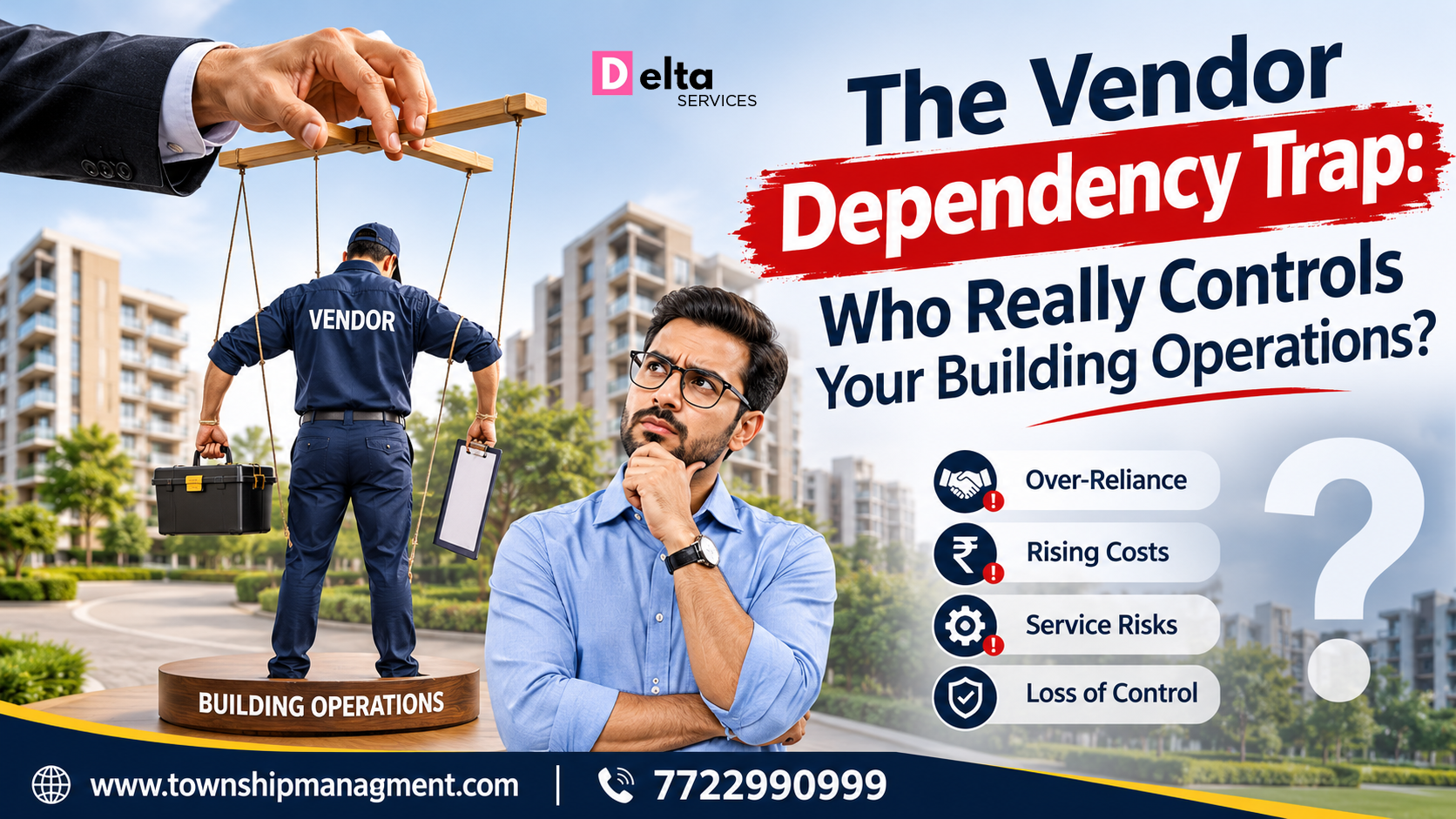
A building may have experienced maintenance contractors, established service agreements and multiple external suppliers. But what happens when one of those vendors becomes unavailable, delays a critical repair or starts controlling the cost and timeline of essential services?
This is where vendor dependency in facility management becomes a serious operational concern. The challenge is not simply finding reliable vendors. It is ensuring that the building's management team retains control over decisions, service quality, costs and operational continuity.
Modern residential societies, commercial complexes, retail properties, hospitals and institutional buildings depend on several external service providers. These vendors may handle electrical maintenance, HVAC servicing, lift maintenance, fire safety equipment, housekeeping supplies, pest control, security systems and other essential services.
Initially, outsourcing these activities may appear convenient. A specialist contractor brings technical expertise, manpower and equipment without requiring the property owner to manage every activity internally.
However, problems begin when the relationship becomes difficult to manage. A contractor may become the only source of technical information, equipment history, spare parts or service support. Management may not know the actual condition of assets, the status of pending repairs or the precise scope covered under an agreement.
Over time, the organization may lose visibility into its own infrastructure.
This situation is known as the vendor dependency trap. It occurs when an external service provider becomes so essential that replacing, evaluating or challenging its performance becomes difficult.
Effective facility management vendor management ensures that external expertise supports building operations without taking away management control.
Vendor dependency refers to an organization's excessive reliance on one or a limited number of external contractors for important services, maintenance activities, technical knowledge, materials or operational support.
Vendor relationships are a normal part of building maintenance management. The risk develops when there are no effective alternatives, performance checks, documentation practices or contingency arrangements.
These situations can affect both residential and commercial properties. The solution is not to avoid outsourcing. It is to establish a structured vendor management system that protects the property's operational interests.
A vendor may submit a service report stating that an inspection, repair or maintenance activity has been completed. But does the management team have independent confirmation?
Without inspection records, work orders, photographs where appropriate and authorized sign-offs, it becomes difficult to verify service delivery.
Strong contractor performance monitoring ensures that completed work is checked against the agreed scope and documented properly.
Unexpected repair expenses are sometimes unavoidable. However, repeated cost increases without transparent quotations, supporting documents or technical explanations should be investigated.
When only one vendor is considered for every repair, management may lose the opportunity to compare pricing, evaluate alternatives and understand the actual cost of materials and labour.
A structured maintenance cost control process includes quotation comparisons, approval limits, expense records and periodic budget reviews.
Building infrastructure includes electrical panels, generators, HVAC units, fire protection systems, lifts, CCTV equipment and access-control systems.
If equipment specifications, maintenance history, service instructions and fault records are not available to the management team, the building becomes dependent on the contractor's knowledge.
Proper asset management requires organized documentation that remains accessible to authorized management personnel.
A lift breakdown, generator failure, electrical fault or HVAC problem can disrupt building operations. If the designated contractor is unavailable, there must be a clear escalation procedure.
Every critical service should have defined emergency contacts, response expectations and backup arrangements.
This is an important part of emergency facility management and operational continuity planning.
Annual Maintenance Contracts can simplify equipment servicing. But an AMC is useful only when both parties understand what is included, what is excluded and which responsibilities belong to the service provider.
Ambiguous agreements may result in disagreements over spare parts, labour charges, emergency visits, preventive inspections and replacement responsibilities.
Effective AMC management helps management teams track contract coverage, service schedules, exclusions and renewal requirements.
A contractor who performed well last year may not necessarily deliver the same service quality today. Manpower changes, delayed responses, incomplete jobs and inconsistent reporting can gradually affect performance.
Regular vendor performance evaluation helps identify these issues before they become serious operational problems.
What happens if a contractor discontinues its services, changes its commercial terms or repeatedly fails to meet expectations?
If the building has no documented handover process, updated equipment records or alternative service arrangements, changing vendors can become unnecessarily difficult.
A well-managed contractor management process should include documentation, transition responsibilities and continuity arrangements.
Vendor dependency does not remain limited to procurement or maintenance departments. Its effects can spread across the entire property.
Limited vendor choices can reduce pricing flexibility. Without transparent quotations and proper expense reviews, maintenance budgets may become difficult to control.
If a critical contractor is unavailable, repair work may be delayed. This can affect lifts, generators, electrical systems, cooling equipment and other essential infrastructure.
Without regular inspections and performance standards, the quality of housekeeping, security, technical repairs and other outsourced services may vary.
Missing work records, unclear invoices and incomplete maintenance reports make it harder for management to understand what is happening across the property.
When technical information remains with an individual contractor, a change in service provider can create confusion and repeat inspections or unnecessary expenses.
Missed inspections, unclear responsibilities and delayed repairs can create avoidable safety concerns. Critical systems such as fire protection, electrical installations and lifts require appropriate inspections and qualified service personnel.
Selecting a contractor is only the beginning of a successful outsourcing relationship. The real responsibility lies in managing the relationship throughout its lifecycle.
| Hiring Vendors | Managing Vendors |
|---|---|
| Selecting a contractor based mainly on price | Evaluating experience, capability, safety and service quality |
| Signing an agreement and waiting for service | Monitoring contract obligations and deliverables |
| Accepting submitted service reports | Verifying completed work and maintaining records |
| Calling the vendor only after a breakdown | Following preventive maintenance schedules |
| Paying invoices without detailed review | Checking quotations, approvals and supporting documents |
| Depending on one contractor for every requirement | Maintaining suitable alternatives and continuity plans |
| Reviewing performance only when complaints arise | Conducting regular performance evaluations |
This difference explains why professional facility management services require more than a list of contractors. They require systems for coordination, monitoring, accountability and continuous improvement.
Every property should maintain an updated record of its service providers. This database should include vendor details, service categories, contact information, contract periods, emergency contacts, qualifications and performance history.
A centralized vendor management system helps authorized teams access essential information without relying on individual employees or contractors.
A Service-Level Agreement (SLA) should establish what the contractor is expected to deliver and how performance will be measured.
Important SLA elements include:
Clear facility management SLA documentation reduces confusion and makes service performance easier to evaluate.
The lowest quotation does not always represent the best long-term value. A contractor should be evaluated on technical capability, relevant experience, manpower availability, safety practices, response capacity and quality of reporting.
A documented vendor selection process helps management make decisions based on both cost and operational suitability.
Asset information should not be stored exclusively with a contractor. Management should retain accessible records of equipment specifications, installation details, service history, warranties, inspections and repair activities.
Strong facility asset management protects institutional knowledge and makes vendor transitions easier.
Performance reviews should be based on clear indicators rather than informal opinions.
Useful vendor performance indicators include:
Consistent contractor performance monitoring makes it easier to identify underperformance and take timely corrective action.
Not every service requires multiple contractors. However, for critical systems, management should assess the consequences of a service interruption and establish suitable backup arrangements.
This may include alternative qualified service providers, emergency contacts, spare-part availability and documented escalation procedures.
A systematic Annual Maintenance Contract management process should track contract start and end dates, service coverage, visit schedules, exclusions, renewal terms and pending obligations.
Periodic reviews help identify contracts that no longer meet the property's requirements or provide adequate value.
Vendor audits help verify whether contractors are delivering services as agreed. Reviews can cover documentation, manpower, work quality, safety practices, material usage and service completion records.
A structured vendor audit process helps maintain accountability and encourages continuous improvement.
Reactive maintenance often creates unnecessary pressure on external contractors. When a system fails unexpectedly, management may have limited time to compare service providers, check prices or plan repair activities.
Preventive maintenance changes this approach by scheduling inspections and servicing before equipment failures occur.
Examples include:
With proper preventive maintenance planning, management gets more time to organize resources, review contractor performance and control maintenance expenditure.
It also supports better building maintenance management by reducing avoidable emergency situations and improving equipment oversight.
Annual Maintenance Contracts are common across residential societies, commercial buildings, hospitals and retail properties. They may cover lifts, HVAC equipment, generators, electrical systems, fire safety equipment and other technical infrastructure.
However, signing an AMC does not automatically guarantee effective maintenance. The contract must be monitored throughout its duration.
Proper AMC management services help reduce misunderstandings, improve service tracking and support better maintenance planning.
A large property may involve multiple service providers across technical maintenance, housekeeping, security, waste management, pest control, customer support and administrative operations.
If each service operates independently, management may face communication gaps, overlapping responsibilities and inconsistent reporting.
Integrated Facility Management Services bring different operational activities under a coordinated management framework. This improves visibility and makes it easier to monitor responsibilities across departments.
A coordinated facility management company can help property owners improve service coordination, maintain consistent operating standards and reduce avoidable gaps between service providers.
Digital tools can make vendor coordination and building maintenance more organized. They can help management teams maintain service records, track work requests, organize equipment information and monitor pending activities.
Depending on the platform and its capabilities, useful facility management software features may include:
Digital records should remain accessible to authorized management personnel. They should support, not replace, physical inspections, technical expertise and proper contractor supervision.
The objective of digital facility management is simple: reduce information gaps and ensure that important operational knowledge does not remain locked with a single service provider.
Property owners, facility managers and administration teams can use the following checklist to evaluate their existing vendor management practices.
If several of these questions cannot be answered confidently, the property may have an opportunity to strengthen its facility management vendor control and operational risk management practices.
Managing a building involves more than arranging repairs whenever something stops working. It requires continuous coordination between people, infrastructure, contractors, resources and management teams.
Professional facility management services help bring these activities into a structured operational framework.
An experienced facility management partner can support property owners through:
The objective is to create a system where service providers remain accountable, maintenance activities are properly coordinated and building management retains operational visibility.
Managing residential societies, commercial buildings, retail spaces and institutional properties requires coordination across several operational functions. Delta Services provides facility management and business support services designed to help properties maintain efficient day-to-day operations.
Its business support service portfolio includes vendor management, procurement support, quality control, preventive management, inventory control, energy management and AMC and insurance management.
Delta Services also offers technical and soft facility management support for residential, commercial and retail properties.
By coordinating essential services and supporting structured operational practices, professional facility management can help property owners improve accountability, service consistency and maintenance planning.
For organizations looking to strengthen their building maintenance management practices, the right facility management approach should focus on transparency, defined responsibilities and long-term operational reliability.
External contractors play an important role in maintaining modern buildings. Their technical expertise, manpower and specialized services can make daily operations more efficient. But outsourcing a service should never mean outsourcing accountability.
When a building depends too heavily on one contractor, management may lose control over service costs, technical information, repair timelines and operational decisions. These risks can be reduced through transparent contracts, documented asset records, regular performance reviews, preventive maintenance and suitable backup arrangements.
Effective vendor management in facility management is not about replacing every contractor or avoiding external expertise. It is about creating a professional system in which every service provider understands their responsibilities and remains accountable for their work.
Ultimately, a well-managed property should never depend on the goodwill or availability of just one vendor. It should have the documentation, processes and professional support needed to keep operations running smoothly.
Vendor dependency occurs when a building relies excessively on one external contractor for critical maintenance, technical support, materials or operational services. It can create risks related to service continuity, cost control, response time and accountability.
Vendor management helps property owners and facility managers evaluate contractors, monitor service quality, manage contracts, control costs and reduce operational risks. It also ensures that external service providers remain accountable for their responsibilities.
Depending on a single contractor can result in delayed repairs, limited pricing flexibility, knowledge gaps, spare-part availability issues and operational disruption if the contractor becomes unavailable.
Facility managers can improve contractor performance through clear Service-Level Agreements, regular inspections, work-order tracking, documented service reports, measurable performance indicators and defined escalation procedures.
A building maintenance contract should define the scope of work, service frequency, response expectations, responsibilities, pricing, exclusions, safety requirements, reporting, escalation procedures, renewal terms and exit arrangements.
AMC management helps track contract coverage, service schedules, renewal dates, equipment responsibilities, service visits and contractor obligations. It supports planned maintenance and reduces the risk of missed services.
Yes. Professional facility management services can introduce structured vendor coordination, contractor evaluation, preventive maintenance, inventory control, quality checks and clear accountability to reduce avoidable operational risks.
Vendor management focuses on selecting, coordinating and evaluating external service providers. Facility management covers the wider operation of a property, including technical maintenance, housekeeping, security, safety, utilities and business support services.
An SLA is an agreement that defines the services a contractor must deliver, expected service standards, response times, responsibilities and performance measurement criteria. It helps management monitor service quality and accountability.
Building owners can reduce vendor dependency by maintaining central asset records, reviewing contracts, monitoring performance, documenting maintenance activities, planning preventive servicing and identifying suitable alternatives for critical services.
Managing multiple contractors, maintenance schedules and building operations can become challenging without a structured management approach.
Connect with Delta Services to explore professional facility management services, vendor management support, preventive maintenance and building maintenance solutions for your residential or commercial property.
Address: 65-68, Vijay Nagar, Scheme No. 78, Indore - 452001
Phone: +91-9343761515
Email: grievance@thedeltaservices.com
Website: www.townshipmanagment.com


Delta services include facility management services. From household to security services. All services are provided on time with efficiency. We also deal in commercial, residential and retail spaces and 24 hours customer support services are available.

65-68, Vijay Nagar, Scheme No. 78, Indore - 452001

+91-9343761515

grievance@thedeltaservices.com
Copyright@2021-22 | Developed By : Hvantage Technologies Inc.